ESTIMATING & PRICING
Print Shop Job Costing: How to Calculate the True Cost of Every Job
A practical method for calculating materials, labor, machine time, outsourcing, overhead, and actual margin on print jobs.
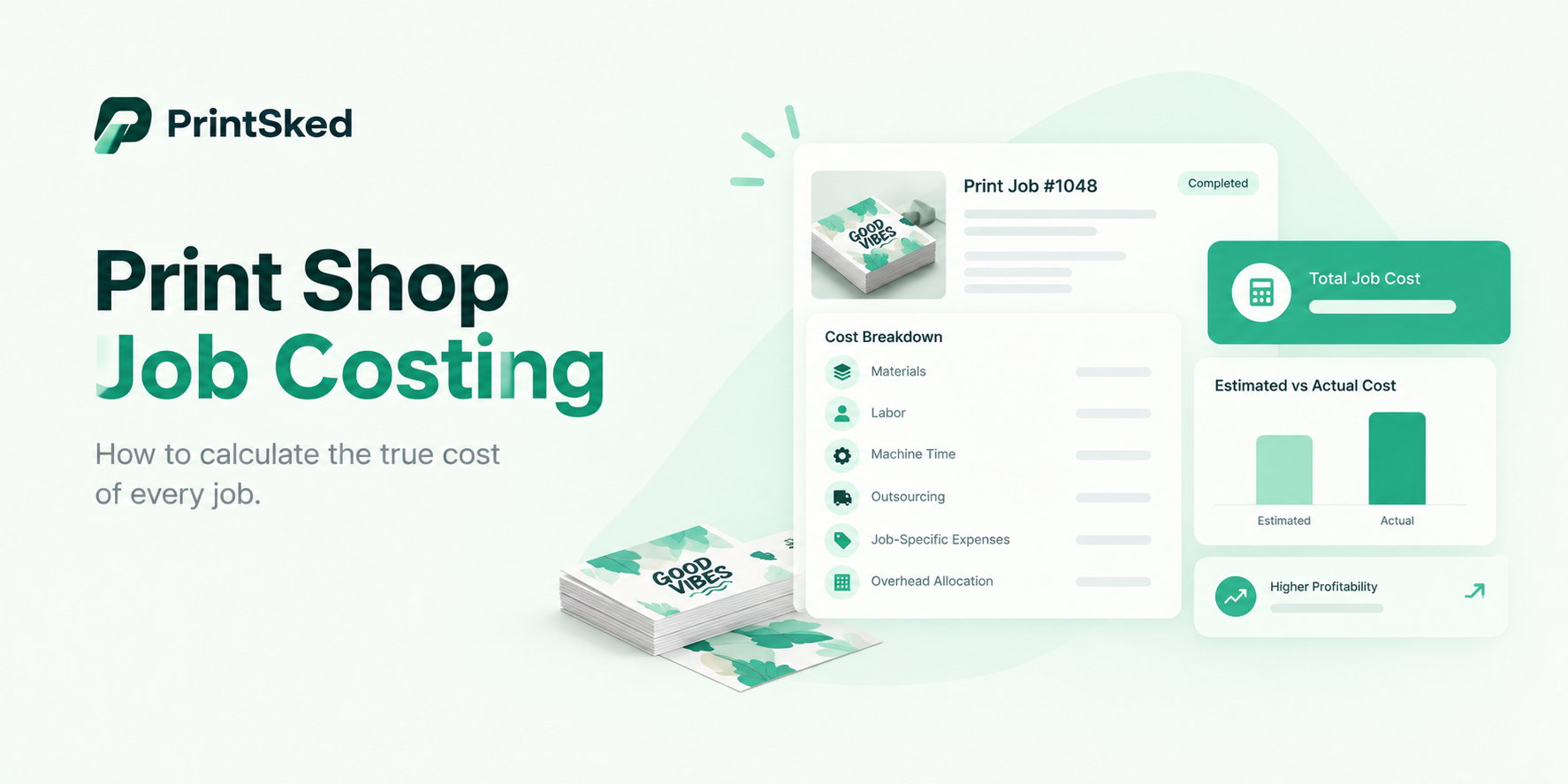
A print job can look profitable on the quote and still lose money on the production floor. The usual reason is not the selling price alone. It is that the shop never calculated the full cost of producing the job.
Job costing gives you a way to answer a basic question with real numbers: what did this job actually cost us to produce?
That answer matters for commercial printing, signs, screen printing, DTF, embroidery, wide format, and almost every custom production business. Once you know the true cost, you can set better prices, identify margin leaks, and stop relying on a general feeling that a job was “good” or “bad.”
What belongs in the cost of a print job?
A useful job cost starts with direct costs. These are costs you can reasonably connect to one job: paper, vinyl, substrate, ink, garments, transfer film, laminate, outsourced finishing, freight, production labor, installation labor, and machine time.
Then there are operating costs that are harder to attach to one order. Rent, insurance, software, utilities, equipment maintenance, management, and non-billable staff time still have to be paid. Your pricing method needs a consistent way to recover them.
The biggest mistake is counting only the material invoice. A $120 roll-media allocation does not tell you what a banner job cost if it also consumed prepress time, printer time, finishing labor, packing, sales handling, and a delivery run.
A practical print shop job costing formula
At its simplest, use:
Total job cost = materials + direct labor + machine cost + outsourced work + job-specific expenses + overhead allocation
Keep the buckets separate. When one number changes, you should be able to see why. That also makes completed jobs useful as future estimating data.
Materials
Cost the material actually consumed, not only the finished dimensions. Sheet yield, roll width, setup waste, spoilage, test prints, and unusable offcuts all matter. If four 12 × 18 pieces require two parent sheets because of grain direction or imposition, cost the two sheets.
For stocked materials, keep the unit cost current. PrintSked’s inventory and purchase order tools are designed to connect material quantities and costs to production rather than leaving purchasing in a separate spreadsheet.
Direct labor
Track the time people spend doing work required by the job. That can include prepress, setup, printing, cutting, laminating, weeding, embroidery setup, finishing, packing, installation, and quality control.
An employee’s wage is not necessarily the correct billable labor cost. Payroll taxes, benefits, paid nonproductive time, and supervision can make the real cost of an hour higher. Decide on a loaded labor rate and use it consistently.
Machine time
Machine cost matters when equipment is expensive to own or operate. A digital press, flatbed printer, router, embroidery machine, laser, or laminator has acquisition, maintenance, consumables, power, and capacity costs. Shops often recover this through a machine-hour rate, click charge, linear-foot rate, or product formula.
The goal is not to create a perfect accounting model. It is to avoid treating machine capacity as free.
Outsourced work and job-specific expenses
Add trade printing, embroidery digitizing, engineering, specialty finishing, freight, permits, lift rental, courier charges, and other costs that exist because the job exists. If you coordinate outsourced work, your selling price should also account for the time and risk involved in managing it.
Worked example: 1,000 folded brochures
| Cost | Amount |
|---|---|
| Paper and expected spoilage | $185 |
| Press clicks and consumables | $95 |
| Prepress and setup labor | $60 |
| Production labor | $110 |
| Folding and packing | $70 |
| Allocated overhead | $80 |
| Total estimated cost | $600 |
If the job sells for $900, the estimated gross profit is $300 and the gross margin is 33.3%. If actual labor runs longer and the completed cost reaches $690, gross profit falls to $210 and margin falls to 23.3%.
This is why selling price alone is a weak performance measure. Revenue can increase while job-level profitability gets worse.
For a deeper pricing framework, read How to Price Print Jobs for Profit. If you quote complex work regularly, custom pricing formulas can help standardize repeatable cost rules.
Estimated cost versus actual cost
Job costing becomes much more valuable when you compare the estimate with the completed job. The estimate records what you expected. Actual costing records what production really consumed.
Track differences in material usage, labor hours, machine time, outsourcing, shipping, installation, and rework. Do not overreact to one unusual job. Look for repeated variance.
If lamination repeatedly takes 40 minutes when estimates assume 20, fix the standard. If small digital jobs consistently lose money because setup is not covered, introduce a minimum. If one customer creates repeated proof revisions, decide whether your pricing and revision policy reflect that workload.
Useful rule: a costing system should help you change future decisions. If you collect numbers but never update pricing, production standards, or purchasing, the reporting is not doing enough.
Markup and margin are not the same thing
A 30% markup on a $100 cost produces a $130 selling price. The gross margin is about 23.1%. If you want a true 30% gross margin, divide cost by 0.70, producing a selling price of about $142.86.
This distinction matters when your team builds price matrices. A formula that applies markup while management thinks it is applying margin will systematically underprice work.
How to build a job costing habit that lasts
Start with your highest-volume or highest-value products. Define the normal material, labor, machine, and outsourced cost assumptions. Record actual time and material on completed jobs. Review variance monthly, then update standards when a pattern is clear.
Keep the quote, job, time entries, material usage, invoice, and profitability report connected. PrintSked’s reports and analytics and print shop software are built around that connected workflow.
You do not need perfect costing on day one. You need a consistent model that gets more accurate as real jobs pass through it. That is what turns costing from bookkeeping into a pricing advantage.
Run your shop with the job details connected.
PrintSked brings quoting, production, approvals, scheduling, inventory, and reporting into one system built for print, sign, and apparel shops.