How to Price Print Jobs for Profit
A practical guide to calculating job costs, setting profitable prices, using markup and margin correctly, and learning from what each job actually costs to produce.
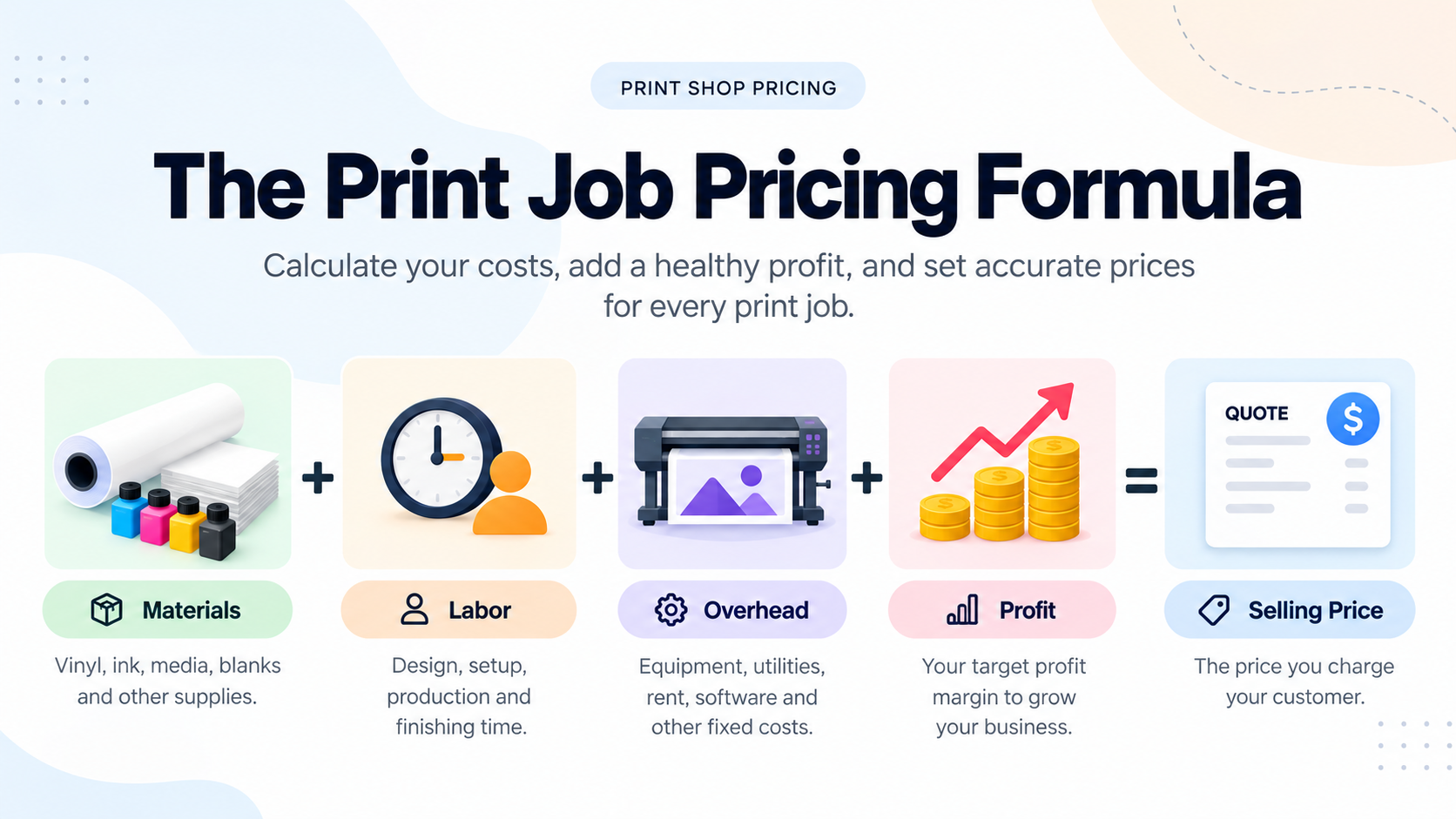
Pricing a print job is easy when you only look at the material.
A banner uses a certain amount of vinyl. A sign uses a sheet of substrate. A shirt has a blank cost. Add a little extra and send the quote.
The problem is that material is only one part of what the job costs your shop.
There is labor to prepare artwork, run equipment, finish the product, pack the order, install the job, and handle revisions. There is machine time, waste, ink, consumables, outsourced work, shipping, rent, software, utilities, and the time your team spends managing the customer.
If those costs are not reflected in your price, a job can look profitable while quietly eating into your margin.
A reliable print pricing method starts with one question: What does this job actually cost us to produce? Once you know that, you can decide what margin the job needs and build a selling price that makes sense.
Key takeaways
- Price the whole job, not just the material used.
- Include direct labor, machine time, finishing, outsourced work, and overhead in your cost.
- Do not treat markup and profit margin as the same percentage.
- Use minimum charges and setup fees for small jobs that still consume shop time.
- Quantity breaks should reflect real production efficiencies, not arbitrary discounts.
- Build repeatable pricing formulas for products you quote regularly.
- Compare quoted costs with actual labor and material use so future prices improve.
1. Know what the print job really costs
Start with the costs you can connect directly to the job. For a wide-format job, that might include substrate, vinyl, laminate, ink, finishing supplies, packaging, and installation materials. For apparel, it could include blanks, transfers, ink, thread, screens, setup, and outsourced decoration.
Then add the labor required to produce it. That includes more than the person standing at the printer. Prepress, artwork preparation, setup, finishing, packing, installation, and job administration all take time.
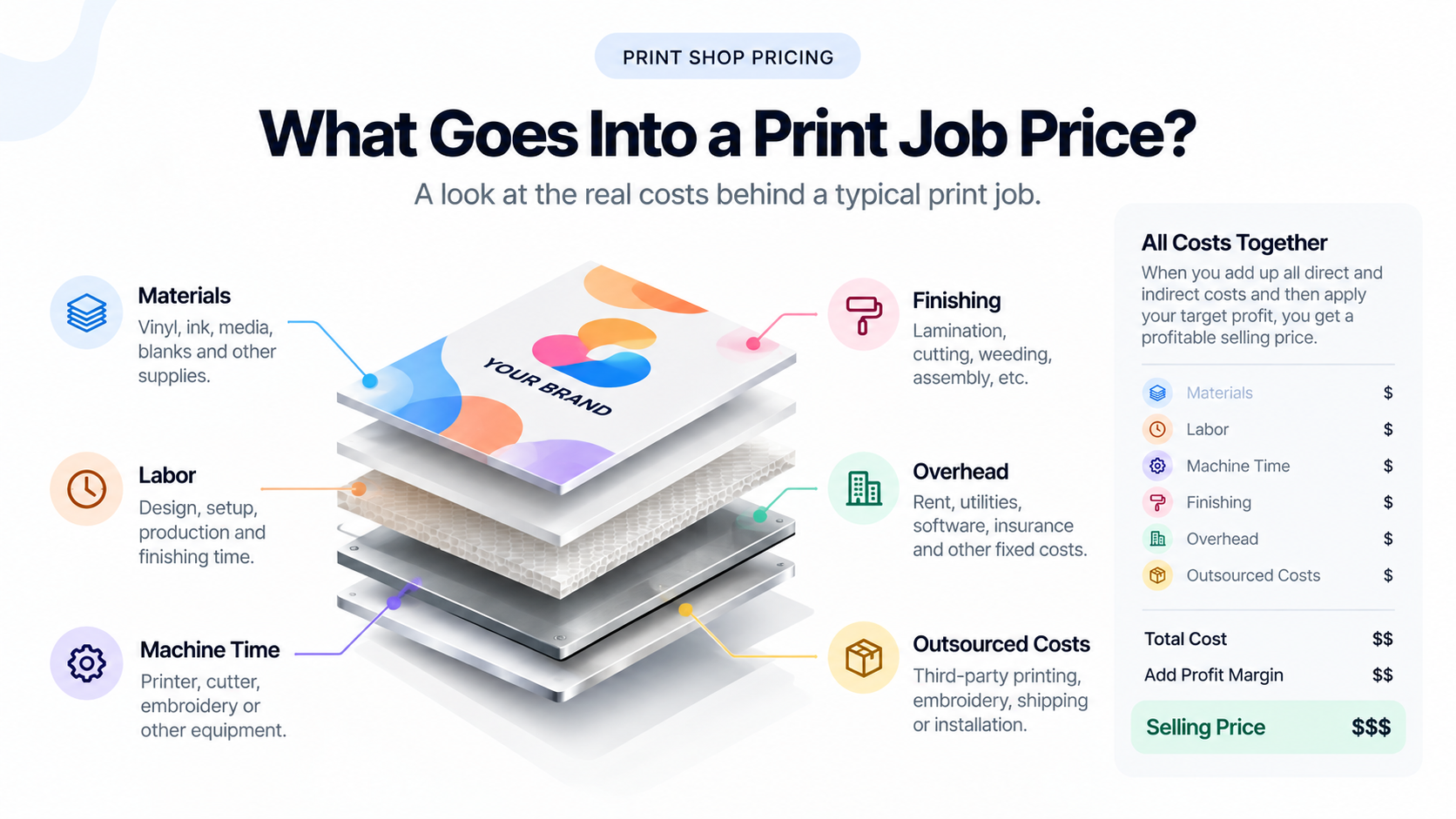
A profitable selling price starts with a complete view of what the job costs the shop.
If a job uses $80 of material and $70 of direct labor, your cost is not automatically $150. You still need to account for the resources that keep the shop operating.
2. Account for overhead without making pricing complicated
Rent, utilities, equipment payments, software, insurance, maintenance, non-production wages, and other operating expenses do not belong to one specific job, but every job needs to contribute toward them.
You can recover overhead in several ways. Some shops build an hourly burden rate into labor or machine time. Others use a percentage on top of direct costs. The exact method matters less than applying it consistently and reviewing it as your expenses change.
A useful rule: if the shop would still pay the expense even when one particular job disappeared, it is probably overhead rather than a direct job cost.
3. Understand markup vs. profit margin
Markup and margin are related, but they are not interchangeable.
Markup is the percentage you add to your cost. Margin is the percentage of the selling price that remains after the cost.
If a job costs $100 and you add a 40% markup, the selling price is $140. Your profit is $40, but your profit margin is only 28.6%.
If you want a true 40% margin on that same $100 cost, the selling price needs to be $166.67.
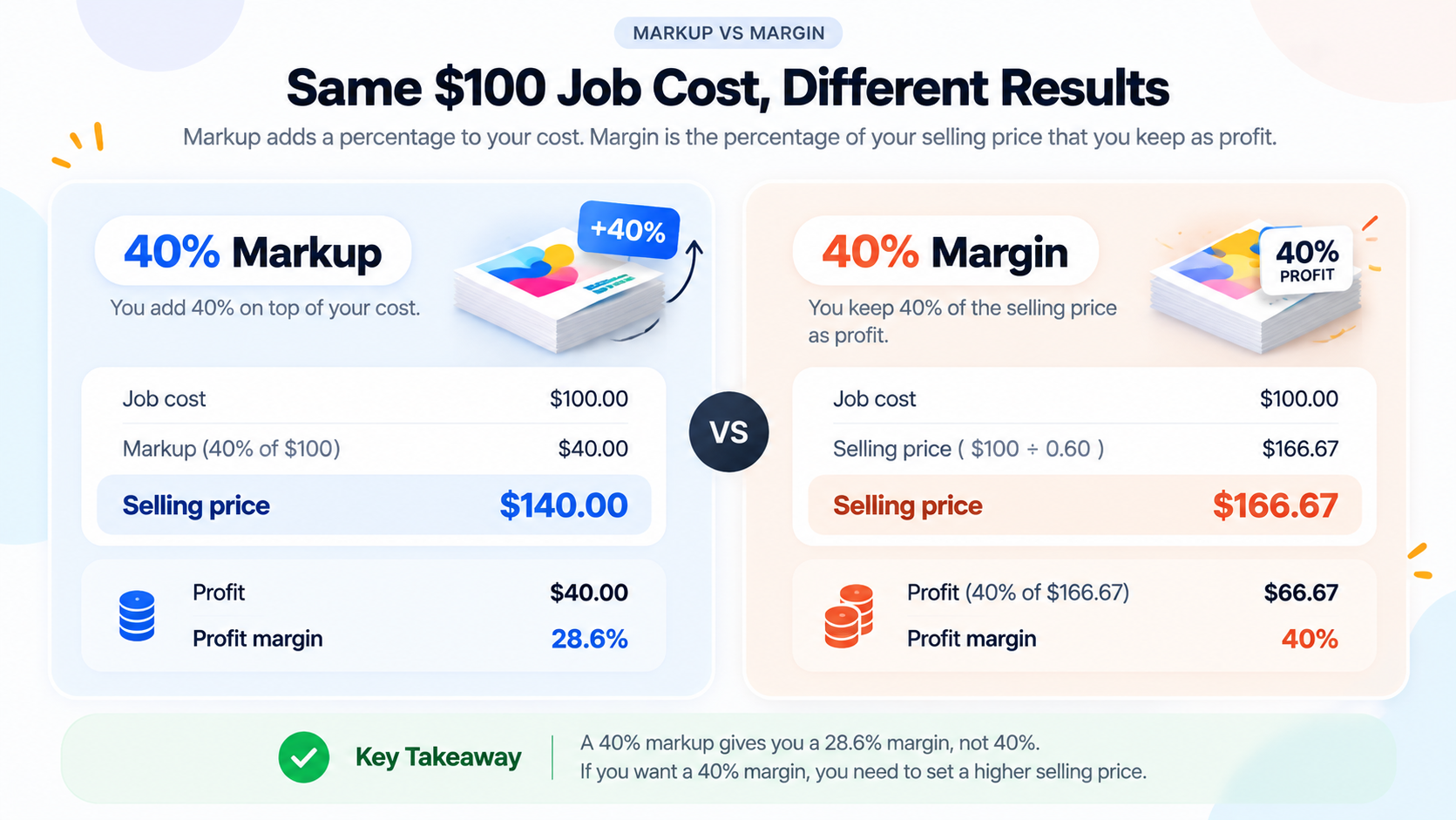
This distinction matters when you set margin targets. A shop that thinks it is pricing for a 40% margin but is actually applying a 40% markup will consistently earn less gross profit than expected.
4. Use minimum charges and setup fees
Small jobs can be some of the easiest jobs to underprice. A customer may only need one small sign or a short run of prints, but the order can still require customer service, file checking, machine setup, production, finishing, invoicing, and pickup.
A minimum charge protects the shop from spending 30 or 45 minutes processing a job that only generates a few dollars of gross profit. Setup fees can serve the same purpose when a process has a fixed amount of work regardless of quantity.
Instead of asking whether a minimum price looks high compared with the material cost, ask whether it fairly covers the time and resources required to put the job through the shop.
5. Build quantity breaks around real production efficiency
Higher quantities often reduce the cost per piece because setup is spread across more units. That does not mean every larger order should receive an arbitrary discount.
Look at where your production economics actually change. If producing 25 banners is materially more efficient per piece than producing one, your price can reflect that. If the job still requires nearly the same labor per unit, a steep quantity discount may simply give away margin.
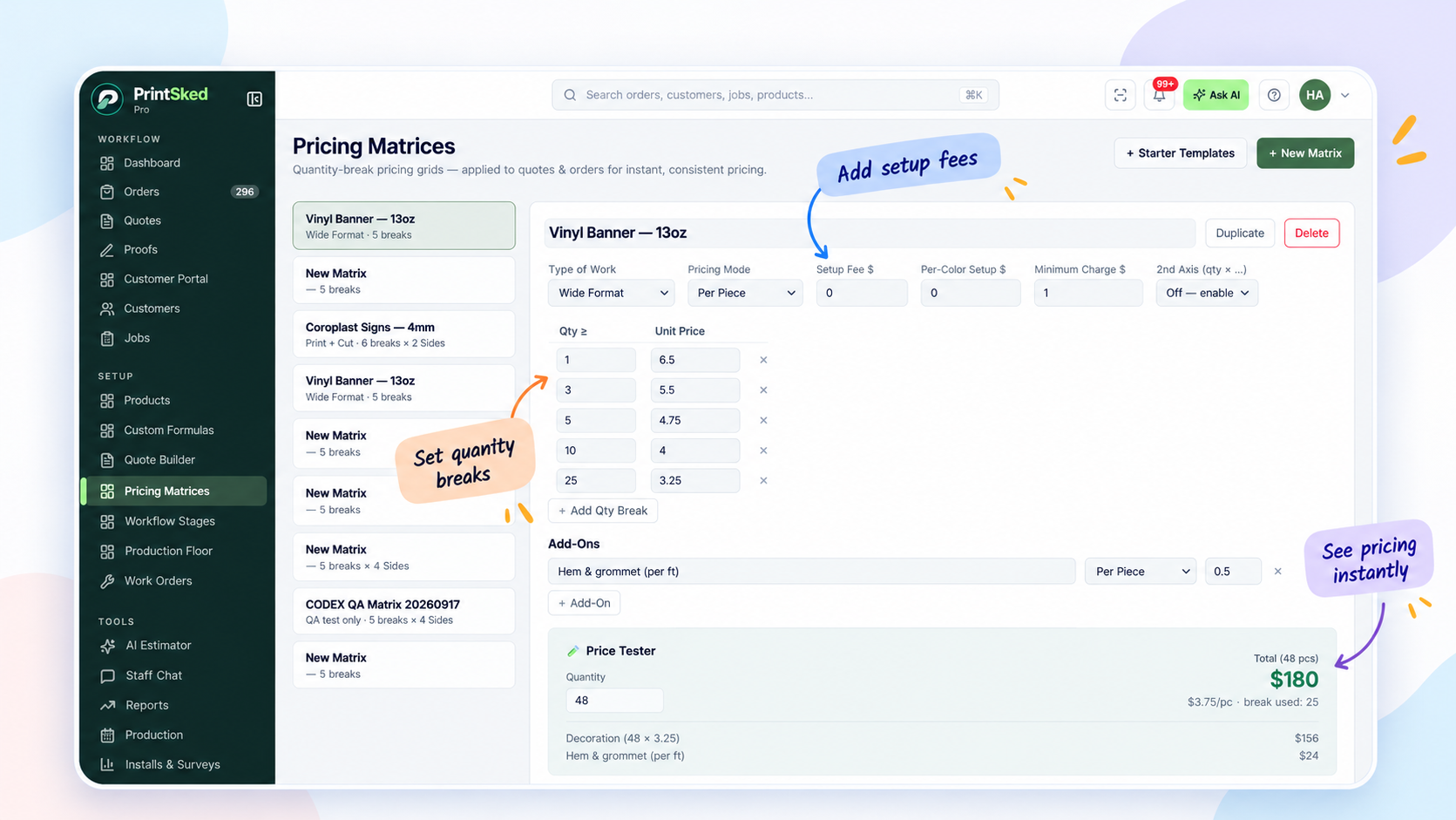
Quantity-break pricing can keep repeat products consistent while reflecting real production efficiencies.
6. Turn repeat jobs into pricing formulas
If your team regularly prices banners, yard signs, decals, apparel, channel letters, or other repeat products, you should not have to rebuild the calculation every time.
A formula can combine dimensions, square footage or square meters, quantity, material rate, labor, setup fees, minimum prices, machine costs, and markup into a repeatable method.
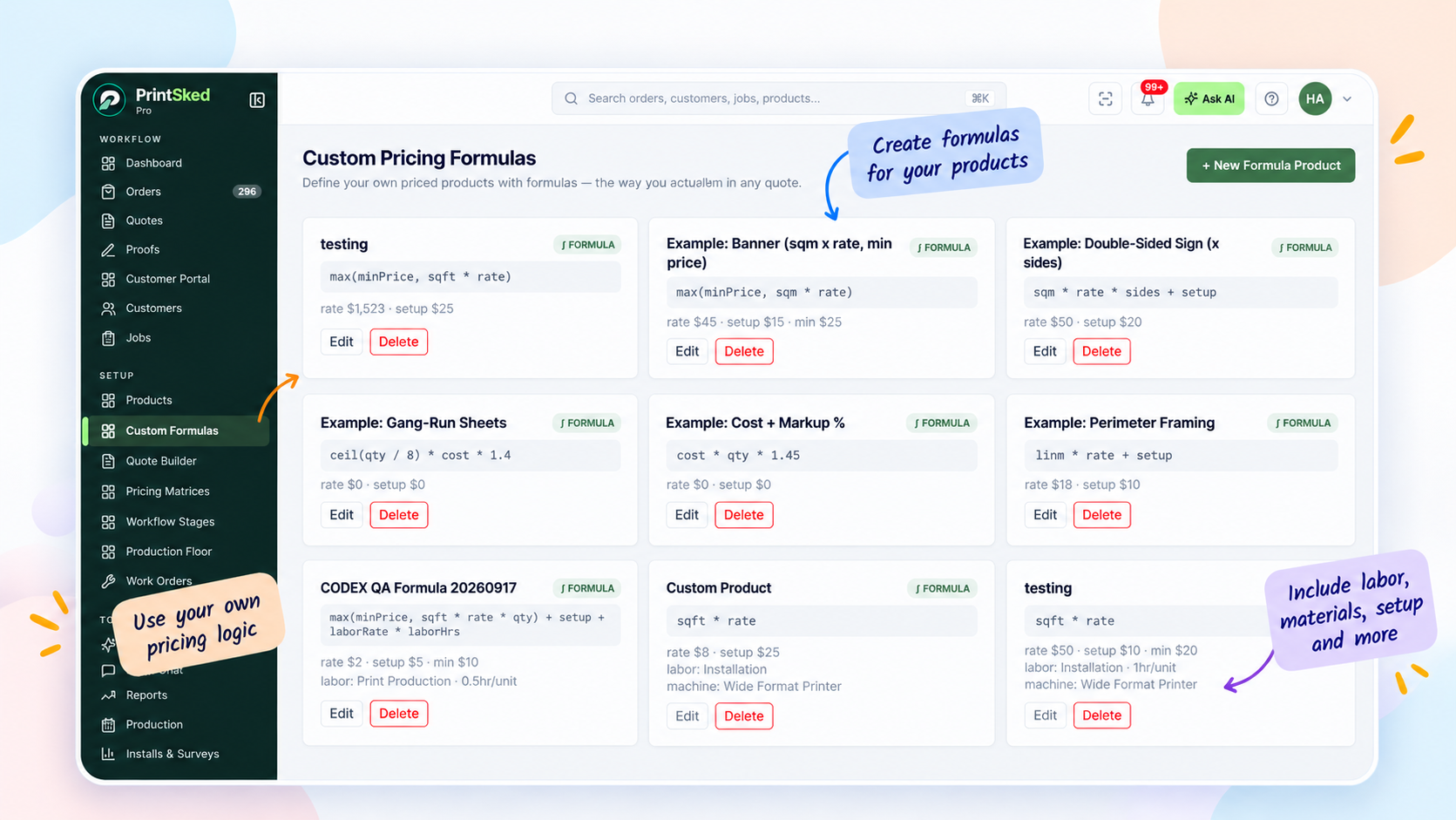
Custom pricing formulas help shops turn repeat pricing logic into a consistent quoting method.
The benefit is not just speed. It reduces the difference between how two salespeople price the same job and makes it easier to update pricing when material or labor costs change.
7. Check the margin before the quote leaves the shop
A selling price can look reasonable and still miss your margin target. Before the quote goes to the customer, the estimator should be able to see the expected cost, selling price, and margin.
This is especially useful when a salesperson applies a discount, changes a quantity, adds installation, or chooses a different pricing tier. You want to see the effect before the customer approves the price.
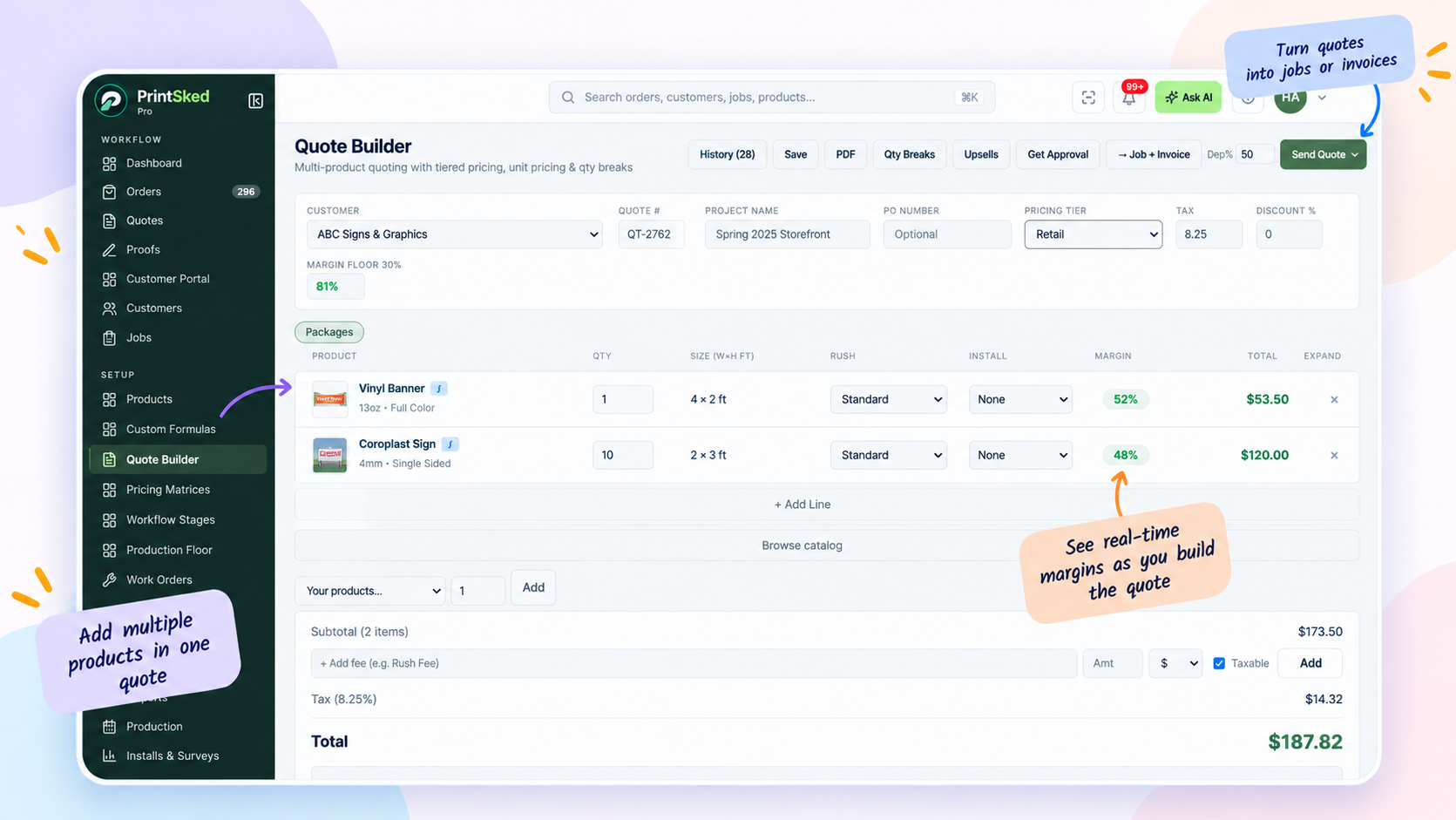
Seeing margin while building the quote helps protect profitability before the price reaches the customer.
8. Compare quoted costs with what actually happened
Your pricing system gets better when completed jobs feed information back into the next estimate.
If you quoted one hour of production labor and the job repeatedly takes two, the estimate needs to change. If material waste is consistently higher than expected, your material allowance may be too low. If installation routinely takes longer than the sales team assumes, that should show up in future pricing.
Tracking quoted versus actual labor, materials, and job costs turns completed work into pricing data rather than letting the same estimating mistakes repeat.
This is also where a connected workflow helps. When quoting, production, time, materials, and reporting live together, you can see whether the assumptions behind your price matched reality.
Profitable print pricing should be repeatable
There is no single markup or margin that is right for every print shop or every product. Your equipment, labor rates, overhead, market, production process, and service level are different from the shop down the road.
What matters is having a pricing method you can explain and repeat.
Know the cost. Recover overhead. Set the margin you need. Use minimums where necessary. Build quantity breaks around real efficiencies. Turn repeat work into formulas. Then compare your estimates with actual results and adjust.
That gives you something much more useful than a price list. It gives you a pricing system.
Build more consistent, profitable quotes.
PrintSked brings pricing matrices, custom formulas, quoting, job costing, and margin visibility into one connected workflow.