How to Organize Jobs in a Busy Sign Shop
A practical system for keeping sign jobs, priorities, due dates, production stages, and responsibilities clear when the shop gets busy.
A busy sign shop can have dozens of jobs moving at the same time. One job is waiting for artwork. Another needs customer approval. A vehicle wrap is ready for production, a set of channel letters is waiting on fabrication, and an install crew needs to know what is happening tomorrow.
The problem is not simply having a lot of work. The problem starts when nobody has one reliable view of where each job stands, what needs attention next, and who is responsible for moving it forward.
Good job organization gives every job a clear place in the workflow. Your team should be able to look at the shop's workload and understand what is new, what is approved, what is in production, what is overdue, and what is ready for installation without chasing updates through email, chat, paper notes, or separate spreadsheets.
Key takeaways
- Give every job a defined stage instead of relying on informal status updates.
- Keep due dates, priorities, ownership, and production details attached to the job.
- Use one job board so sales, design, production, and installation work from the same information.
- Separate urgent work from work that is simply new.
- Plan production around real capacity, not just a list of due dates.
- Make overdue work visible before it becomes a customer problem.
1. Define the stages every job moves through
Start by making the workflow visible. A typical sign shop might use stages such as Lead, Quoted, Approved, In Design, In Production, Quality Check, Ready to Install, and Completed. Your exact stages should reflect how your shop actually works.
The important part is that a stage has a specific meaning. If a job is marked Approved, everyone should know what must already be complete and what happens next. If it is In Production, production should have the information and files required to do the work.
A clear stage system prevents vague statuses such as “working on it” or “almost ready.” Those phrases do not tell the next person what needs to happen.
2. Keep the right details attached to every job
A job title alone is not enough. At minimum, your team should be able to see the customer, product or project description, quantity, due date, production due date when needed, priority, assigned people, department, artwork or proof status, production instructions, delivery or installation details, and customer PO number when applicable.
Keeping these details with the job reduces the number of times production has to ask sales what was promised. It also gives sales a reliable place to check progress before replying to the customer.
A useful rule: if production regularly has to ask for the same missing detail, that detail should become part of your standard job setup.
3. Use one visual job board
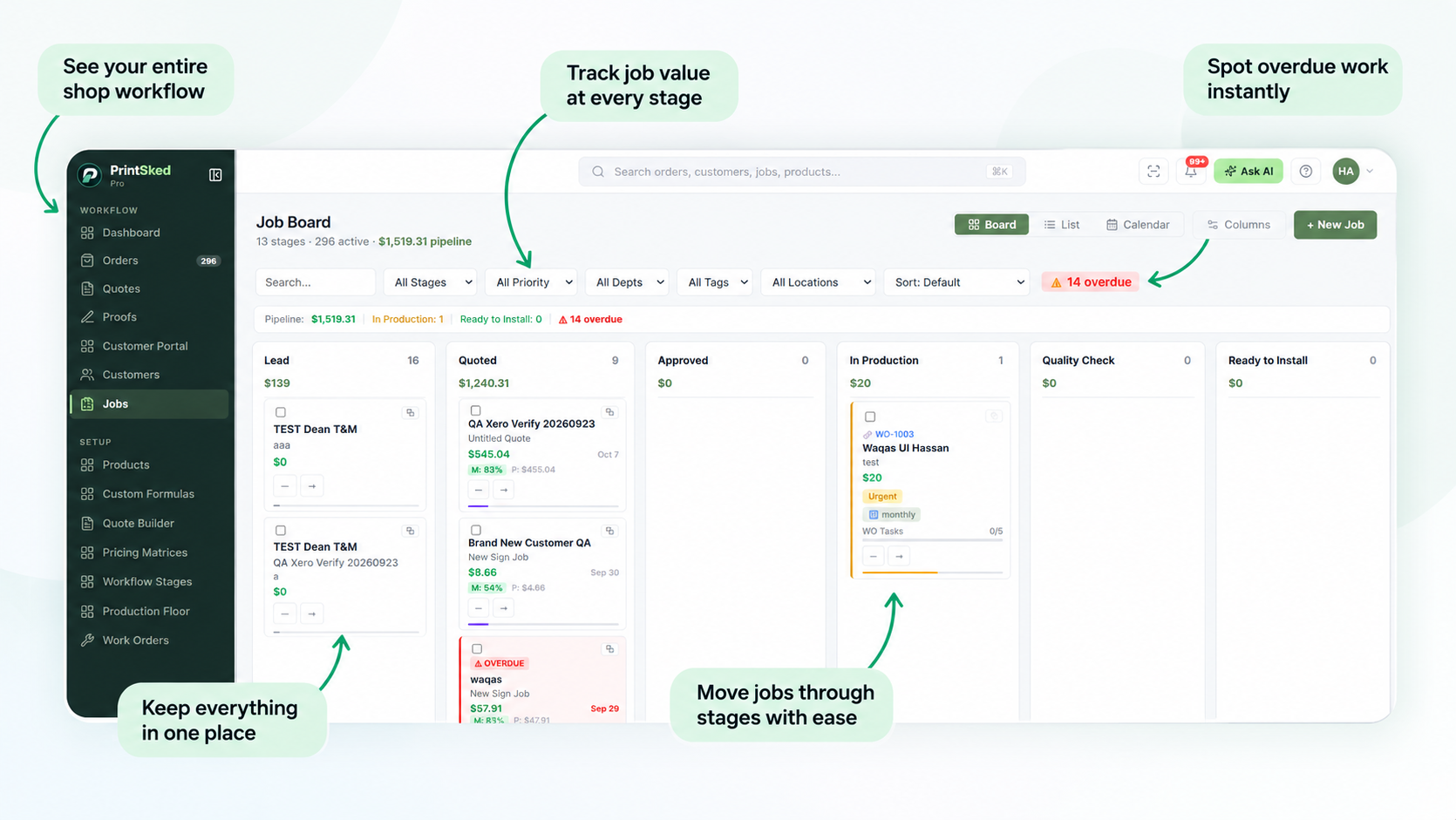
When jobs are organized by stage, a visual board makes the workload easier to understand. Instead of reading through a long spreadsheet, your team can see how many jobs are waiting in each part of the workflow and where work is starting to pile up.
A board is also useful for spotting bottlenecks. If Quoted keeps growing while Approved stays empty, follow-up may be the issue. If In Production is overloaded, the shop may need to adjust scheduling before promising more aggressive due dates.
A visual job board gives the team one view of stages, job value, overdue work, and production progress.
4. Separate job priority from job status
Status tells you where the job is. Priority tells you how urgently it needs attention. Mixing the two makes a board harder to manage.
A new rush job may still be in design. An older job may be in production but have a normal priority. Keep both pieces of information visible so the team knows what the job is waiting on and how quickly it needs to move.
Due dates matter too, but priority should not become a substitute for proper scheduling. If everything is marked urgent, nothing is actually prioritized.
5. Plan production around real capacity
A job board answers “where is the job?” Production planning answers “when and where will we make it?” Busy sign shops need both views.
Large-format printers, flatbeds, routers, laminators, fabrication areas, and install crews all have limited capacity. When several jobs need the same resource, a due-date list does not show the conflict clearly enough.
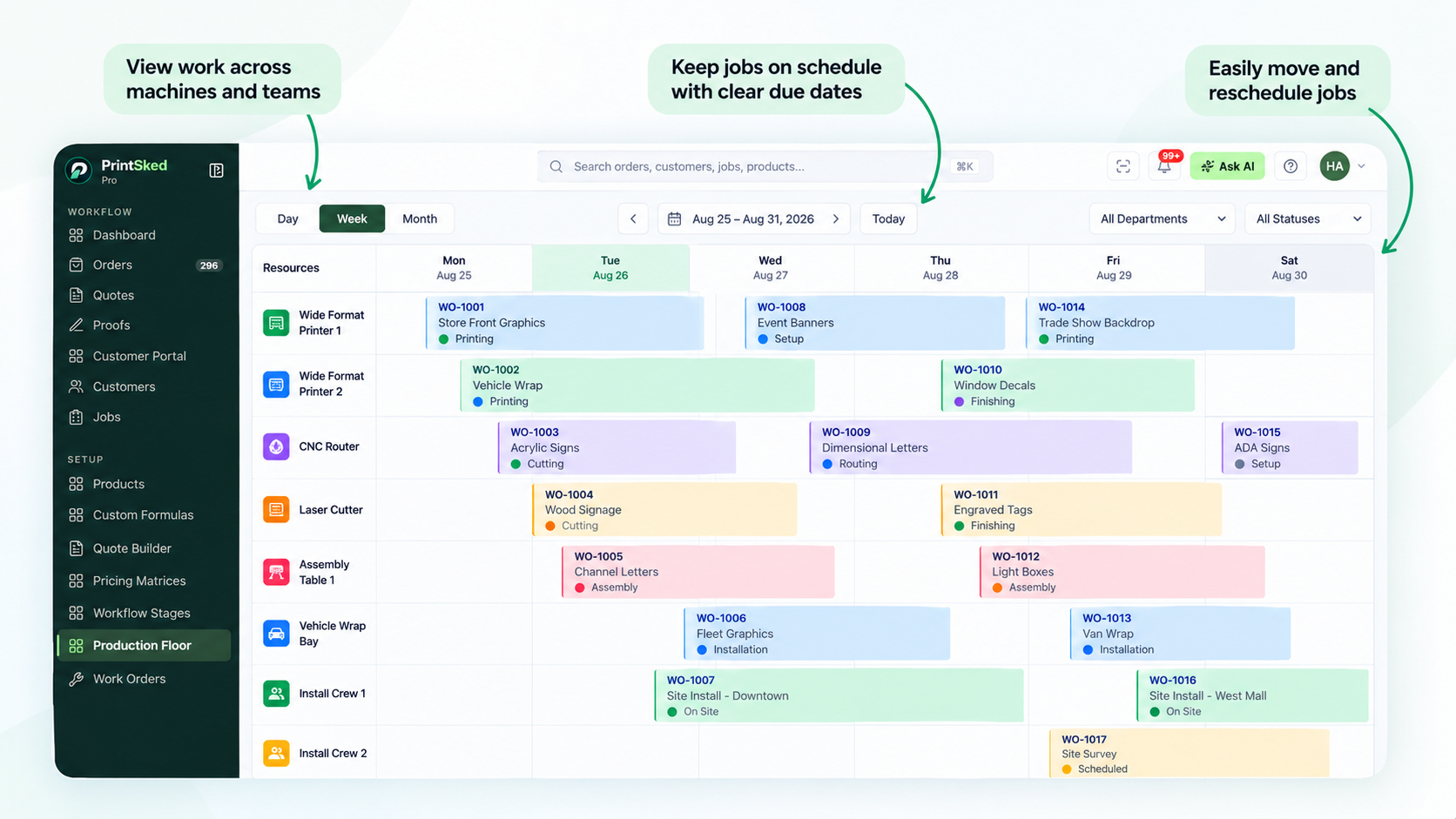
Production scheduling makes machine and team capacity visible so jobs can be moved before a bottleneck becomes a missed deadline.
Plan work against the resource that actually has to perform it. This makes it easier to see whether Friday is overloaded, whether one printer is carrying too much work, or whether an installation needs to move before the customer is affected.
6. Review the board every day
A job system only works when the information stays current. A short daily production review can keep the board useful without turning into a long meeting.
Focus on jobs due soon, overdue work, jobs blocked by approvals or files, jobs waiting for materials, production capacity for the next few days, and installations that require coordination.
The goal is not to discuss every job. It is to surface exceptions early and make sure the person responsible for the next step is clear.
Organization should reduce questions, not create more admin
A well-organized sign shop does not require everyone to constantly update multiple systems. It gives the team one place to understand the job, its stage, its deadline, and the next action.
Start with clear stages. Standardize the information each job needs. Use a visual board for shop-wide visibility, then plan production against actual capacity. When those pieces stay connected, the team spends less time asking where jobs are and more time moving them forward.
Keep every sign job moving.
PrintSked connects quoting, job stages, production scheduling, work orders, approvals, and installation so your team can see what needs attention next.
Start free trialBook a demo