How to Create Faster, More Consistent Print Quotes
A practical quoting process for print, sign, and apparel shops that helps your team respond faster without guessing at prices or rebuilding every estimate from scratch.
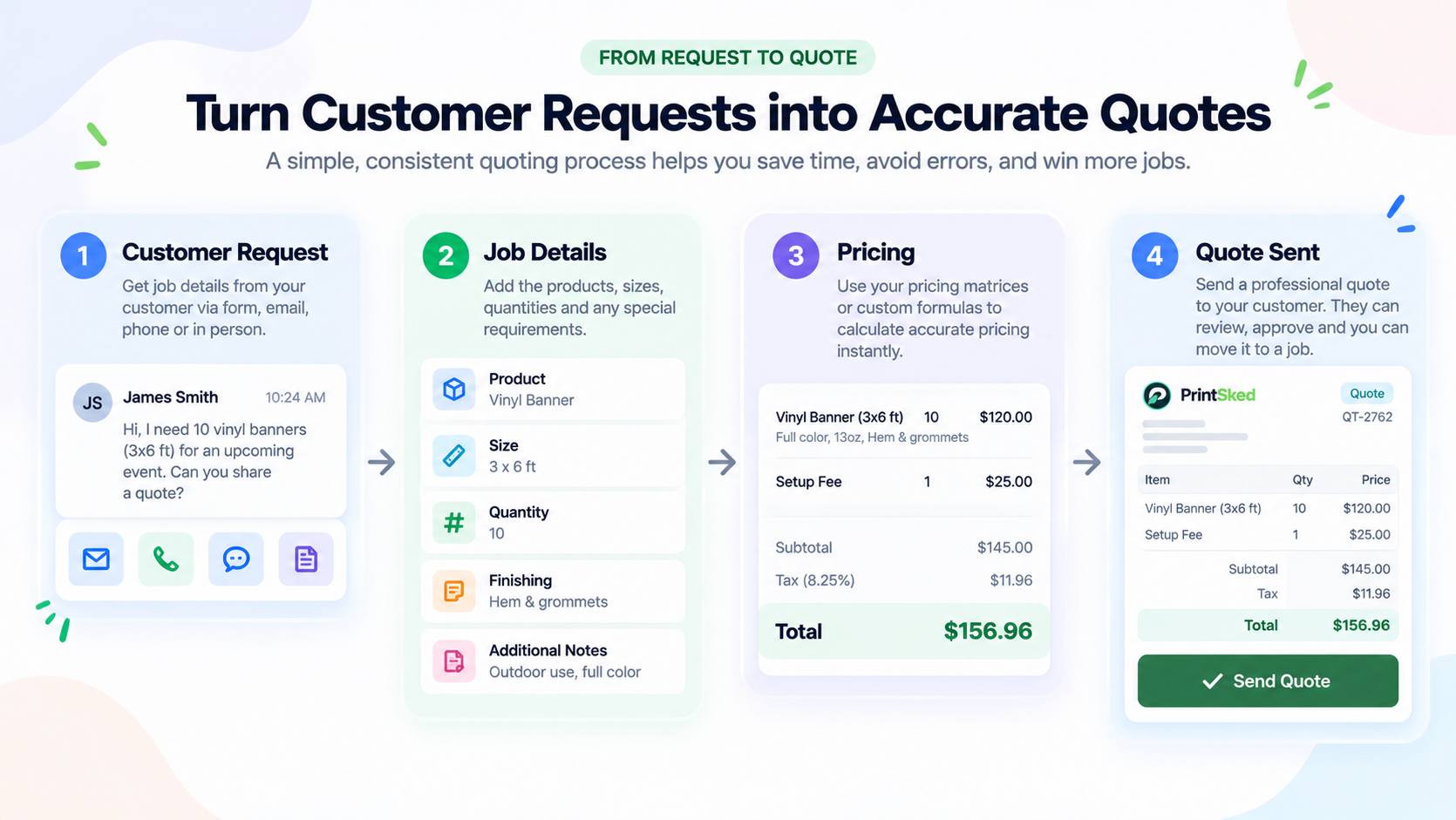
A customer asks for a banner. Another needs 250 shirts. A third sends an incomplete email about vehicle graphics and wants a price by the end of the day.
The hard part is rarely creating a quote document. The hard part is getting the right information, applying the right pricing, and doing it consistently when several requests arrive at once.
When quoting depends on memory, old spreadsheets, handwritten notes, or asking one experienced person what they charged last time, two problems appear quickly. Quotes take longer than they should, and similar jobs can leave the shop at very different prices.
A faster quoting process does not mean rushing. It means removing the repeated decisions that should already have a clear answer.
The goal is to create a system where your team collects the same essential details, uses the same pricing logic, checks the expected margin, and sends a professional quote without rebuilding the process for every customer.
Key takeaways
- Start every quote with complete job specifications instead of trying to price from an incomplete request.
- Standardize the information your team collects before estimating.
- Use pricing matrices and formulas for repeat products instead of relying on memory.
- Include labor, finishing, installation, shipping, and other add-ons before the quote is sent.
- Check margin while building the quote, not after the customer approves it.
- Keep quote versions, customer approvals, and job details connected.
- Once a quote is approved, move its information into production without entering everything again.
1. Start with complete job details
Many slow quotes begin with missing information. A customer asks for “a banner” but does not provide the size, quantity, material, finishing, deadline, or whether installation is required. The estimator starts pricing anyway, then has to stop and ask questions later.
Before calculating a price, define the minimum information required for the type of job you are quoting. For a wide-format product, that might include dimensions, material, quantity, print sides, finishing, artwork status, delivery method, and due date. Apparel may require garment style, sizes, decoration method, locations, colors, and quantities by size.
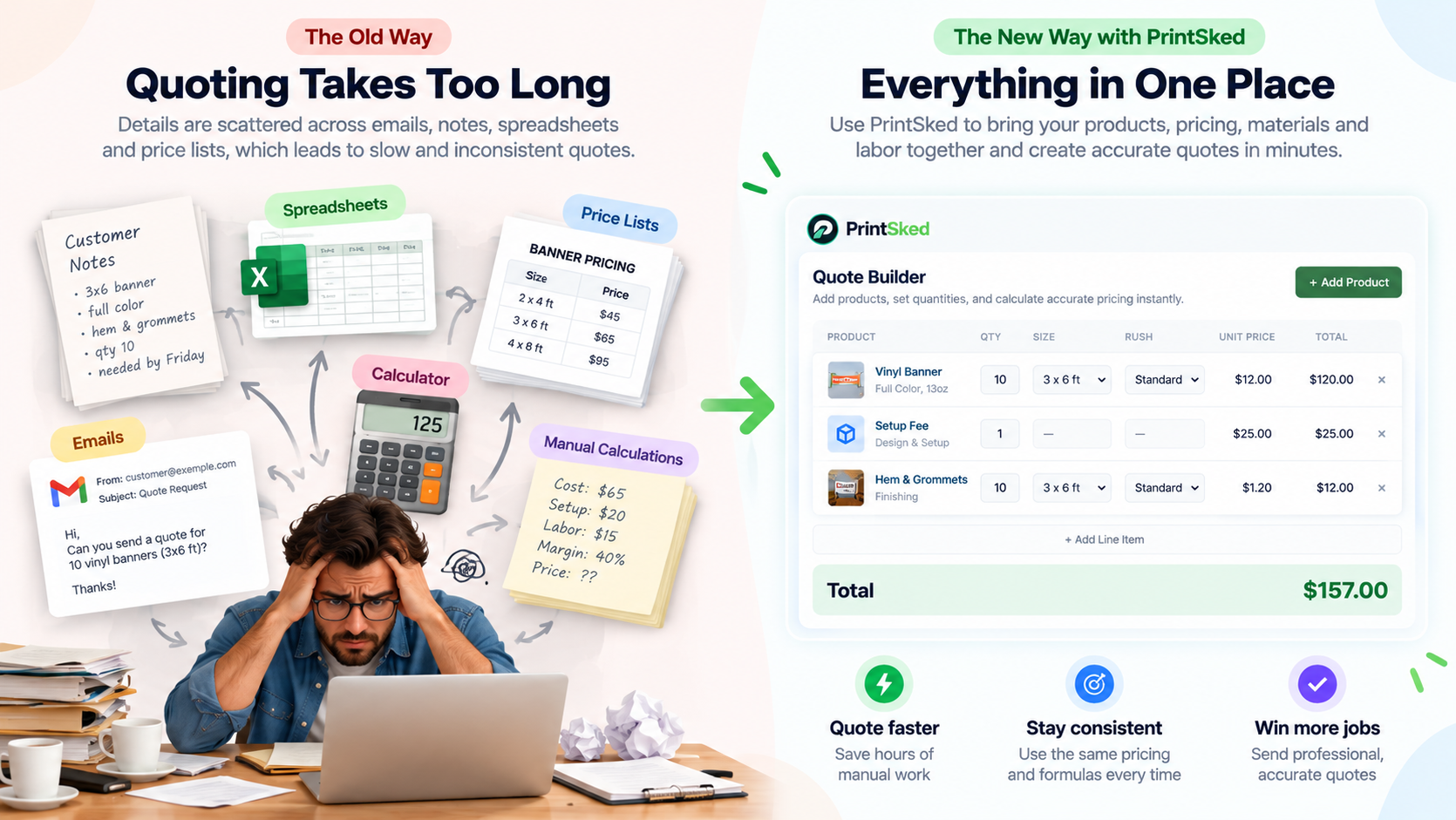
Keeping specifications, pricing inputs, and customer details together reduces back-and-forth during estimating.
The point is not to make the customer fill out a complicated form. It is to give your team a clear standard for what must be known before a reliable price can be produced.
2. Use the same quoting checklist every time
Once the job requirements are clear, the estimator should follow a repeatable sequence rather than relying on memory.
Product specifications come first. Then quantity, materials, labor or production time, finishing, delivery or installation, and finally the pricing and margin check.
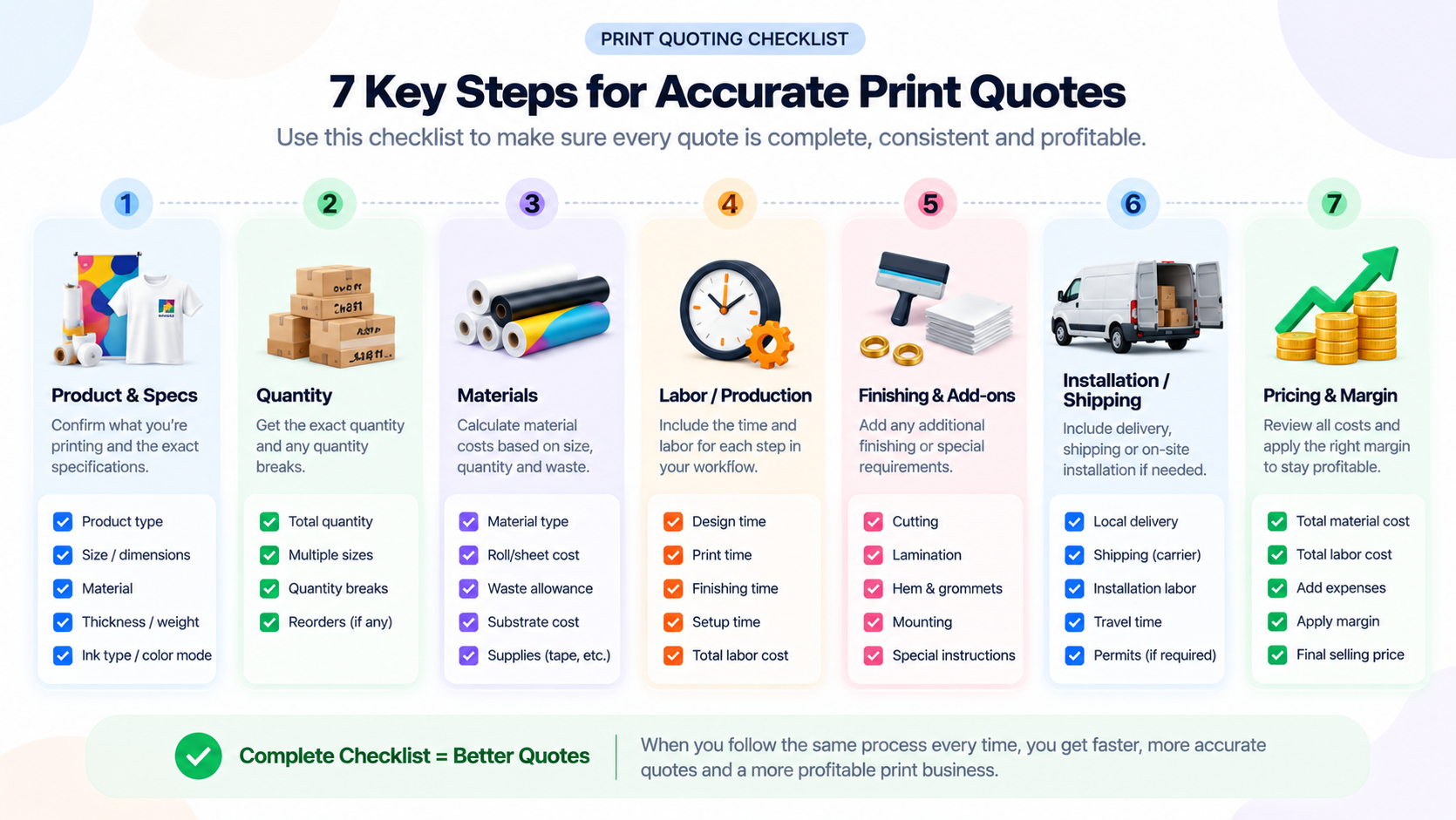
A consistent quoting checklist helps prevent costs and requirements from being missed.
This matters most on jobs that look simple at first. A sign may need mounting hardware. A banner may need hemming and grommets. An apparel order may need setup, sorting, or individual packaging. A vehicle graphic may require design time and installation.
A checklist gives those details a place in the process before the selling price is finalized.
3. Standardize pricing for repeat products
If your shop quotes the same types of products regularly, the pricing logic should not live in one person's head.
For products with predictable quantity breaks, a pricing matrix can define how the unit price changes as quantity increases. For products driven by dimensions, material rates, setup fees, labor, or other variables, a repeatable pricing formula can do the calculation.
This is one of the biggest opportunities to make quoting both faster and more consistent. The estimator still makes decisions about the job, but no longer has to reconstruct the basic pricing method every time.
Consistency does not mean every job gets the same price. It means the same inputs are handled using the same rules, while the estimator can still account for unusual requirements, rush work, installation, or other exceptions.
4. Build the entire quote in one place
A quote becomes harder to manage when customer details are in your CRM, prices are in a spreadsheet, quantities are in an email, product notes are on paper, and the final total is typed into a separate document.
Bringing those pieces together reduces copying and gives the estimator a clearer view of the whole job.
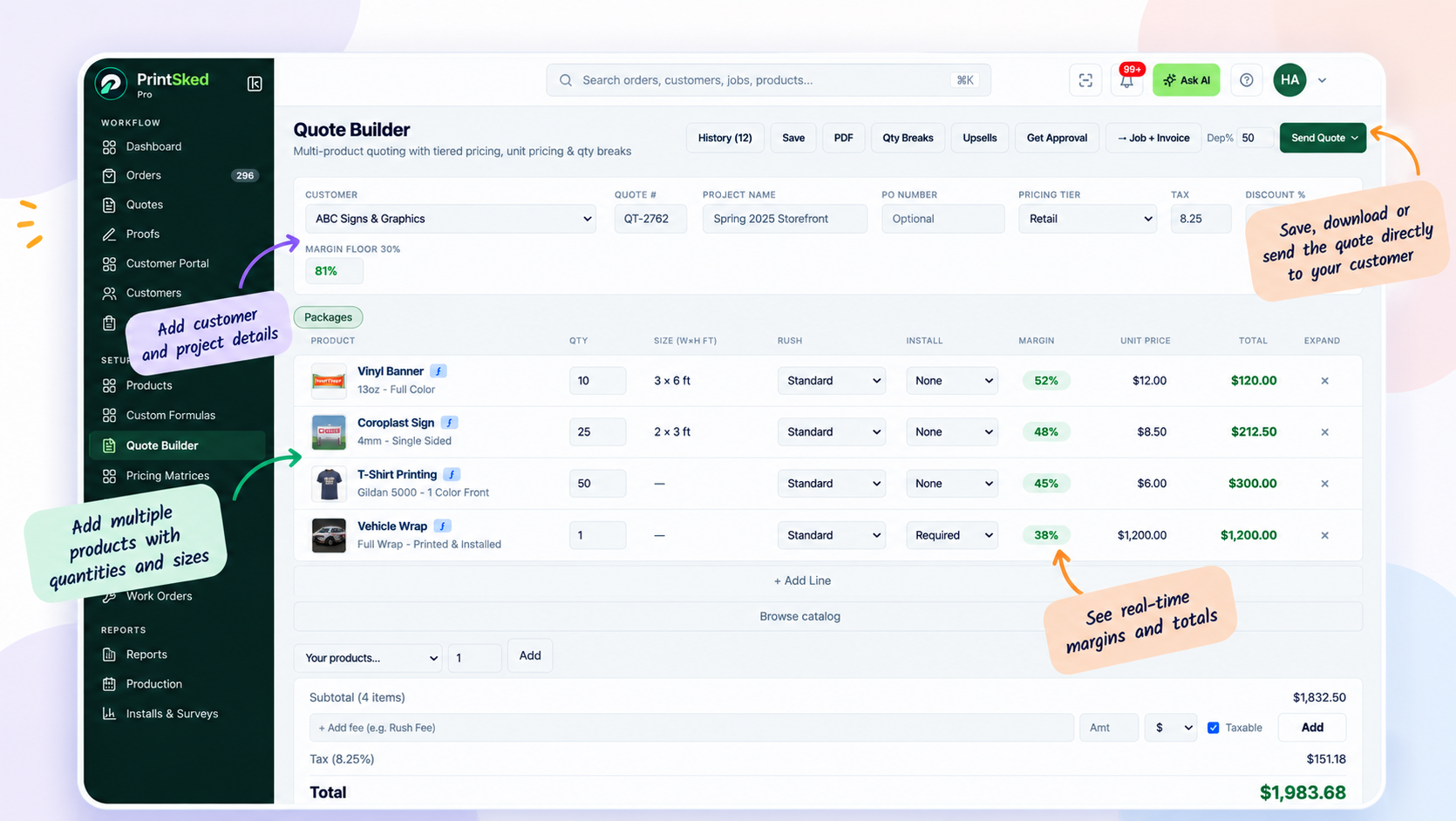
A connected quote builder keeps products, quantities, pricing, margins, taxes, and customer details in the same workflow.
This is especially useful for multi-product jobs. A single customer request may include banners, signs, apparel, installation, and additional fees. Each line needs its own quantity and pricing logic, but the customer still needs one clear quote.
5. Check the expected margin before sending
Speed is not useful if faster quotes are less profitable.
Before the quote leaves the shop, review whether the selling price still meets the margin you expect. Discounts, rush requirements, installation, outsourced work, and unusual materials can change the economics of a job quickly.
This is easier when the estimator can see pricing and margin while the quote is being built. If a discount pushes the job below your target, the team can catch it before the customer sees the price.
For a deeper breakdown of costs, markup, margin, and quantity pricing, see our guide to pricing print jobs for profit.
6. Make quote approval easy for the customer
A quote is not finished when it is emailed. It is finished when the customer makes a decision.
If approval requires downloading a PDF, replying to an email, explaining changes in another thread, and then waiting for someone at the shop to update the status manually, the sales process slows down again.
Give the customer a clear place to review the quote, request changes, comment, and approve. Keep that activity connected to the customer and the quote so the team can see what happened without searching through an inbox.
When revisions are required, keep the new version connected to the same opportunity rather than creating disconnected copies that are difficult to track.
7. Move approved quotes into production without starting over
The information collected during quoting is valuable after the sale. Product specifications, quantities, materials, due dates, customer details, files, notes, and pricing should not have to be entered again just because the work is now called a job.
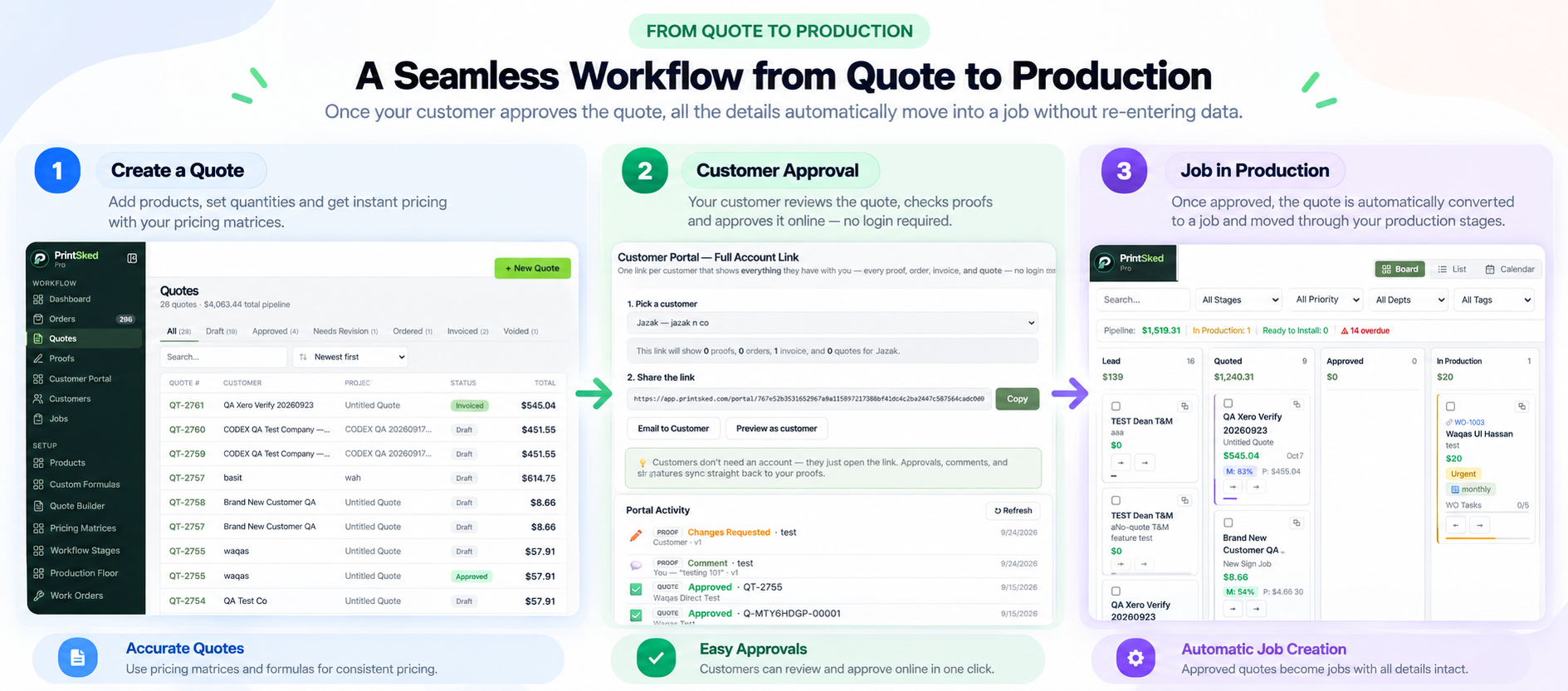
Keeping the quote, customer approval, and production job connected reduces duplicate entry and lost information.
A connected handoff also makes it easier for production to understand what was sold. Instead of interpreting a salesperson's notes or looking through old emails, the team can work from the information already approved by the customer.
This is where quoting becomes part of the broader print shop workflow rather than a separate administrative task.
Faster quoting comes from fewer repeated decisions
The best way to speed up quoting is not to type faster. It is to stop solving the same problems from scratch.
Define the information every quote needs. Build repeat products around consistent pricing rules. Give estimators a checklist for labor, materials, finishing, delivery, and margin. Keep customer approvals connected to the quote. Then carry the approved details directly into the job.
That creates a process your team can repeat even when the shop gets busy, and customers get a faster response without your pricing becoming less reliable.
Quote faster without losing control of your pricing.
PrintSked connects products, pricing matrices, custom formulas, quoting, customer approvals, and jobs so your team can move from request to production in one workflow.