Sign Shop Estimating: How to Quote Signs Accurately and Profitably
A practical guide to estimating materials, labor, fabrication, installation, overhead, and margin without relying on guesswork.

Sign estimating gets difficult for one simple reason: you are rarely selling only a piece of material.
A customer may ask for a 4 × 8 sign, but the job behind that request can include a full sheet of ACM, printed vinyl, laminate, trimming, routing, hardware, artwork preparation, production time, travel, a two-person installation crew, lift access, permits, and the risk of returning to the site because something was missed during the survey.
If the estimate captures only the obvious material and a few labor hours, the quote can look profitable while the completed job tells a different story.
This guide shows a practical way to estimate sign work from the first customer conversation through the final quote. We will use an ACME storefront sign as a running example, then look at how the method changes for banners, channel letters, monument signs, vehicle graphics, and installation-heavy work.
What a reliable sign estimate should do
- Define exactly what the customer is buying before calculating a price.
- Convert finished dimensions into the material you actually have to purchase and use.
- Separate production labor from installation labor.
- Include fabrication, hardware, outsourced work, travel, equipment, and permits when they apply.
- Recover overhead without hiding every cost inside an arbitrary square-foot rate.
- Produce enough gross profit to make the job worth doing.
- Give production the same scope that sales quoted.
- Compare the estimate with actual job costs so the next quote improves.
Start with scope, not price
The most expensive estimating mistakes often happen before anyone opens a calculator. The estimator assumes what the customer means, prices that assumption, and production later discovers that the actual job is different.
Before pricing, turn the request into a clear production scope. For a basic flat-panel sign, that means answering questions such as:
- What are the exact finished dimensions and quantity?
- Is the sign single-sided or double-sided?
- What substrate and thickness are required?
- Is the graphic printed, cut vinyl, painted, routed, dimensional, or a combination?
- Does the print need laminate?
- Are edges square, rounded, routed, folded, or framed?
- Is artwork supplied and production-ready?
- Does the existing sign need to be removed?
- How will the new sign be mounted?
- Who is responsible for installation, electrical work, permits, and site access?
- Is there a fixed completion date or rush requirement?
Those are not administrative details. Each answer can change cost.
Estimator rule: if a missing detail can change the material, production method, labor time, or installation method, resolve it before treating the quote as final.
Build the estimate in cost buckets
Breaking the estimate into cost buckets makes it easier to see what you missed and easier to compare quoted cost with actual cost later. A useful structure for sign work is material, graphics, fabrication, shop labor, hardware, outsourced work, installation, travel and equipment, permits, and overhead.
1. Materials: estimate what you consume, not just finished area
A 4 × 8 finished sign has 32 square feet of face area. That does not automatically mean your material cost is 32 times a square-foot rate.
Sheet goods are purchased in sheet sizes. Roll media has fixed widths. Some jobs leave reusable offcuts and others create waste that is difficult to use. Your estimate needs to reflect the material that will actually be consumed.
For sheet material, think in sheets first. If a 47 × 95 inch finished panel requires a full 4 × 8 sheet, the job consumes one sheet even though the finished area is slightly smaller. If two smaller signs nest on one sheet, their material cost should reflect that yield.
For vinyl and laminate, roll width matters. A 54-inch roll may handle a 48-inch graphic efficiently. A 60-inch-wide graphic may force you into a wider roll, a seam, or a different production method. The finished square footage alone does not show that.
2. Graphics and finishing
Printed vinyl, laminate, application tape, paint, cut vinyl, masking, and specialty films should be estimated according to the production method. Add realistic waste for setup, trimming, registration, and failed output. A shop that assumes every printed square foot becomes a billable square foot will usually understate media usage.
Finishing can also be a meaningful labor cost. Trimming, weeding, masking, laminating, mounting, edge finishing, drilling, hemming, grommeting, and packaging all consume time even when the raw material is inexpensive.
3. Shop labor
Do not estimate labor as one vague number if several departments touch the job. Separate the work enough to understand where the time goes. A flat-panel sign might include prepress, printing, laminating, mounting, trimming, drilling, quality check, and packing.
The labor rate should cover more than the employee's wage. A productive shop-hour rate may also need to recover payroll burden and a share of operating costs. What matters is that the rate reflects what an hour of production capacity actually costs the business.
4. Fabrication and hardware
Fabricated signs can add routing, welding, bending, painting, returns, raceways, frames, posts, brackets, fasteners, anchors, sealants, LEDs, power supplies, wiring, and other components. Small hardware is easy to forget because no single fastener changes the quote much. Across many jobs, unpriced hardware becomes a real margin leak.
5. Outsourced work
If you outsource engineering, wholesale fabrication, electrical components, specialty printing, crane service, concrete work, or installation, use the vendor's expected cost and decide how the shop will recover the coordination and risk involved. Passing an outsourced invoice through at cost leaves no room for project management, payment timing, rework, or vendor issues.
Worked example: estimating a 4 × 8 ACM storefront sign
Suppose ACME needs one 4 × 8 exterior storefront panel made from 3mm ACM with a full-color print and UV laminate. The panel needs trimming, drilled mounting holes, hardware, and installation by a two-person crew.
For illustration, assume the estimate is built like this:
| Cost item | What it covers | Estimated cost |
|---|---|---|
| Materials | 3mm ACM sheet including expected waste | $245 |
| Print & laminate | Full-color output and UV laminate | $160 |
| Fabrication | Trim, edge work, drilling | $120 |
| Shop labor | Prep, production, finishing | $180 |
| Hardware | Stud mounts, fasteners, sealant | $50 |
| Installation | Two-person crew, three hours on site | $320 |
| Travel & permits | Travel time, parking, permit allowance | $80 |
| Total estimated cost | $1,155 |
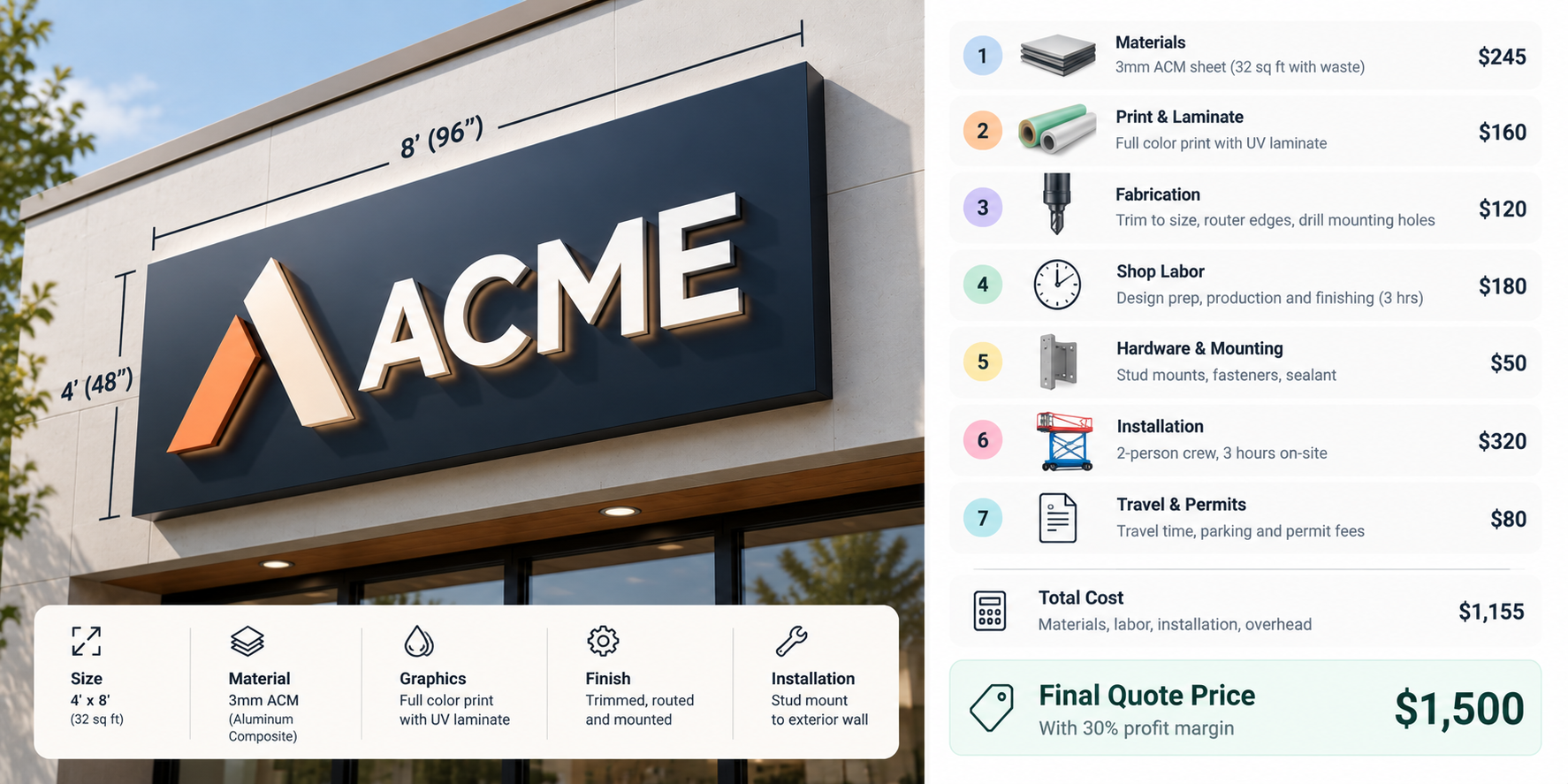
A worked estimate is easier to audit when materials, production, installation, and other costs remain visible instead of being buried in one rate.
The important lesson is not that a 4 × 8 ACM sign should cost $1,500. It should not be used as a market price. The useful part is the structure. The estimator can see why the job costs what it costs and can change the estimate when the scope changes.
If the customer removes installation, the cost changes visibly. If the wall requires a lift, the cost changes visibly. If the artwork arrives production-ready, prepress time can be adjusted. If two identical panels can be produced together, setup and labor may be shared.
Square-foot pricing is useful, but it is not the whole estimate
Square-foot pricing is convenient for products where area is strongly related to material and machine usage. Banners, printed vinyl, flat panels, and some large-format work are common examples.
The mistake is treating square footage as if it explains the entire job.
Consider two signs that are both 32 square feet. One is a simple printed ACM panel picked up by the customer. The other requires routed edges, stand-off hardware, a site survey, a two-person crew, a lift, and installation above a storefront. Their face area is identical. Their costs are not.
A better approach is to use square-foot pricing for the part of the job that behaves by area, then add the costs that behave differently. Those may include minimum charges, setup, finishing, fabrication, hardware, installation, equipment, travel, artwork, and permits.
Square footage answers “how much surface are we producing?” It does not answer “what does it take to complete this job?”
Standardize repeatable products without forcing every job into the same formula
Not every estimate needs to start from zero. If your shop sells the same product types repeatedly, build standard product definitions for them.
A vinyl banner can have a base material, common finishing, standard grommet spacing, and quantity rules. Flat sign panels can have standard substrates and thicknesses. Channel letters can have common configuration choices. Vehicle graphics can have saved product structures even though each vehicle still needs job-specific input.
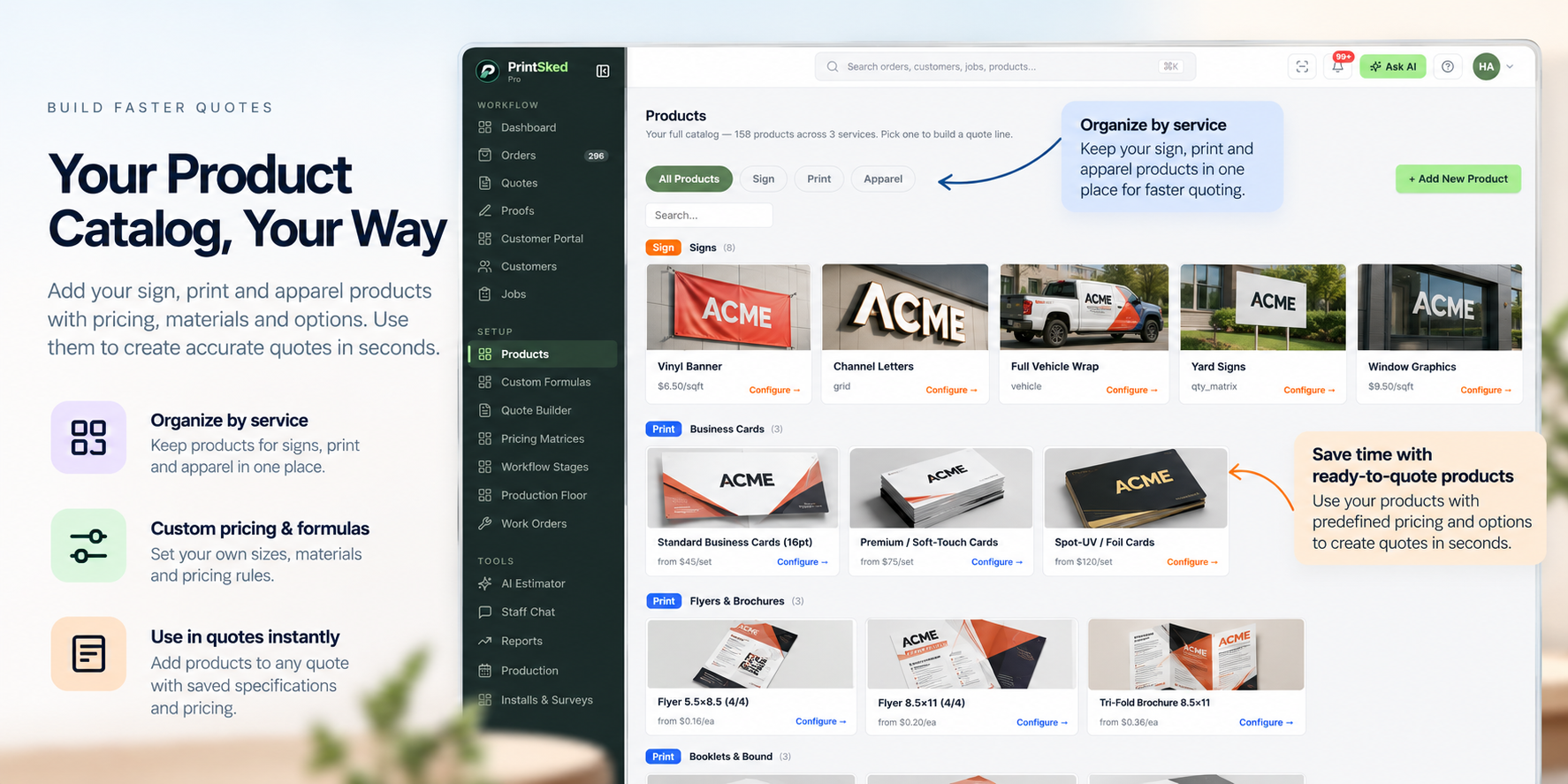
A product catalog gives estimators a consistent starting point while still allowing the job-specific details to change.
The purpose of standardization is not to remove judgment. It is to stop your team from repeatedly typing the same assumptions and remembering the same charges. See how PrintSked handles custom pricing and formulas for repeatable products.
The estimating method should change with the sign type
A common pricing problem is trying to force every sign through one formula. Different products have different cost drivers.
Banners
Area is a strong starting point, but include hemming, grommets, pole pockets, wind slits if used, finishing labor, minimum order charges, packing, and shipping. Very small banners can be unprofitable if a pure square-foot rate ignores setup and handling.
Flat panels and yard signs
Material yield matters. Estimate how many finished pieces fit on a sheet, then add printing or vinyl, cutting, routing, drilling, stakes or mounting hardware, and packing. Quantity can improve efficiency because setup is shared, but finishing labor still grows with piece count.
Channel letters
Channel letters are driven much more by fabrication than simple face area. Letter count, letter height, stroke complexity, returns, trim cap, faces, LEDs, power supplies, raceway or direct mounting, electrical access, engineering, permits, and installation conditions can all affect the estimate. A price per letter or per inch can be a useful starting rule only if the configuration behind that rule is clearly defined.
Monument and pylon signs
These jobs can involve fabricated cabinets, structural steel, posts, footings, concrete, masonry, electrical work, engineering, excavation, equipment, permits, traffic control, subcontractors, and multiple site visits. Treating the sign face as the main cost driver can seriously underprice the project.
Vehicle graphics and wraps
Material area matters, but vehicle type and installation difficulty matter just as much. Include design and proofing, print and laminate, panel setup, contour cutting when needed, vehicle cleaning and preparation, removal of existing graphics, installation hours, and difficult surfaces. A box truck and a curved passenger vehicle with the same approximate graphic area can require very different labor.
Dimensional letters and wall signs
Material thickness, routing time, paint or finish, studs or spacers, patterns, wall type, access, alignment, and installation height are important. A small dimensional-letter job can carry significant setup and installation time relative to its material cost.
Estimate installation as its own job inside the job
Installation is one of the easiest places for a profitable production estimate to become an unprofitable completed job.
Do not price installation only from the sign's dimensions. Estimate what the crew actually has to do.
Start with crew size and expected on-site hours. Then consider loading and unloading, travel time, site access, working height, ladders, scaffolding, bucket trucks or lifts, drilling and anchoring, electrical work, removal and disposal of existing signage, traffic or pedestrian control, parking, permits, restricted work hours, and cleanup.
A three-hour installation with two people consumes six labor hours before travel is considered.
If the site is unfamiliar, a survey can be cheaper than guessing. Photos help, but they may not reveal wall construction, electrical access, mounting obstacles, safe equipment placement, or local restrictions.
Build a site-survey habit for installation-heavy work
A useful survey should record measurements, wall or ground conditions, mounting surface, installation height, access points, electrical availability, existing signage, obstacles, equipment access, parking, photographs, and anything the crew needs to know before arriving.
The goal is not paperwork. It is to move uncertainty from installation day into estimating, when you still have a chance to price it.
Do not forget the costs that sit between jobs
Some costs are easy to attach directly to a job. Others keep the shop operating regardless of which job is on the table. Rent, software, insurance, non-billable management time, equipment maintenance, utilities, bookkeeping, and sales activity still need to be recovered.
There are several valid ways to recover overhead. A shop may build it into labor rates, machine rates, product pricing, or use a defined overhead allocation. What matters is avoiding double counting and making sure the selling price contributes enough to keep the business running.
Turn estimated cost into a profitable selling price
Once you have a credible cost estimate, you still need to convert it into a selling price.
Do not confuse markup with gross margin. If a job costs $1,000 and you add a 30% markup, the selling price is $1,300. The gross margin is only about 23.1%.
If you want a 30% gross margin on a $1,000 estimated cost, the calculation is:
Selling price = Cost ÷ (1 − target margin)
$1,000 ÷ 0.70 = $1,428.57
For the ACME example, a $1,155 estimated cost at a true 30% target gross margin would require a selling price of $1,650. The $1,500 figure in the example graphic represents a roughly 30% markup on cost, not a 30% gross margin. That distinction matters when you set pricing rules.
If you want to test this quickly, use the Print Shop Profit Calculator or read How to Price Print Jobs for Profit.
Use minimum charges where setup dominates the job
Small jobs can be deceptive. The material may cost only a few dollars, but someone still has to receive the request, prepare the file, load material, set up equipment, produce the piece, finish it, inspect it, invoice it, and hand it to the customer.
If your normal pricing method produces a selling price that cannot cover that handling, use a minimum product or job charge. Minimums are especially useful for small cut-vinyl jobs, one-off decals, tiny panels, minor revisions, and service work where setup is large relative to material.
Price uncertainty instead of pretending it does not exist
Some estimates contain unknowns. A wall may be inaccessible until installation. A permit fee may not be confirmed. Existing graphics may take an uncertain amount of time to remove. Engineering may change after review.
Do not silently absorb every unknown. Depending on the job, use an allowance, clearly state an exclusion, obtain the missing information before final pricing, or explain that additional work requires a change order.
The customer should know what the price includes and what would cause it to change.
Turn the estimate into a quote the customer and production team can understand
A good internal estimate can be detailed without forcing the customer to read every internal cost. The customer-facing quote should clearly describe the deliverable, quantity, size, material or construction, important finishes, installation scope, price, tax where applicable, deposit, expected timing, and key exclusions or assumptions.
Do not let the scope disappear after the quote is approved. The information used to sell the job should follow it into production.
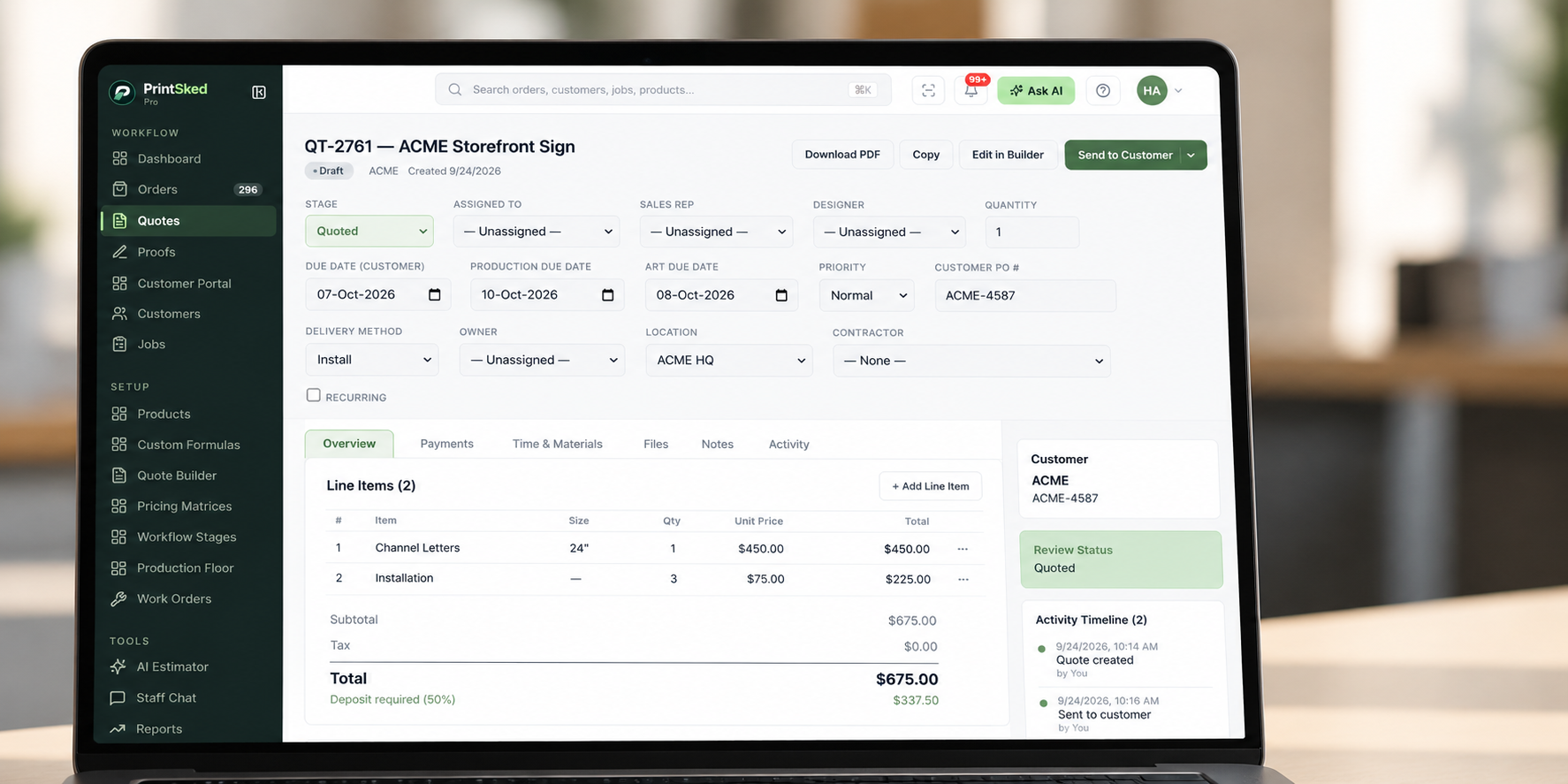
Keeping the approved quote connected to the job reduces the chance that production works from a different scope than the customer approved.
PrintSked's quoting tools connect products, pricing, customer information, approvals, and downstream job details so the estimate does not become a disconnected document.
Deposits and payment terms are part of a healthy estimate
A profitable quote can still create cash-flow pressure if the shop pays for materials and outsourced work long before collecting from the customer. For material-heavy or custom jobs, consider whether a deposit should cover the major upfront commitments.
The right deposit policy depends on your shop and customer relationship, but it should be intentional. Large custom fabrication jobs should not automatically use the same payment structure as a small repeat banner order.
The estimate is not finished when the customer approves it
This is where many shops lose the opportunity to improve.
After the job is completed, compare what you expected with what actually happened. Did production take four hours instead of two? Did you use an extra sheet? Did installation require another crew member? Did a subcontractor charge more than expected? Did the job need a return visit?
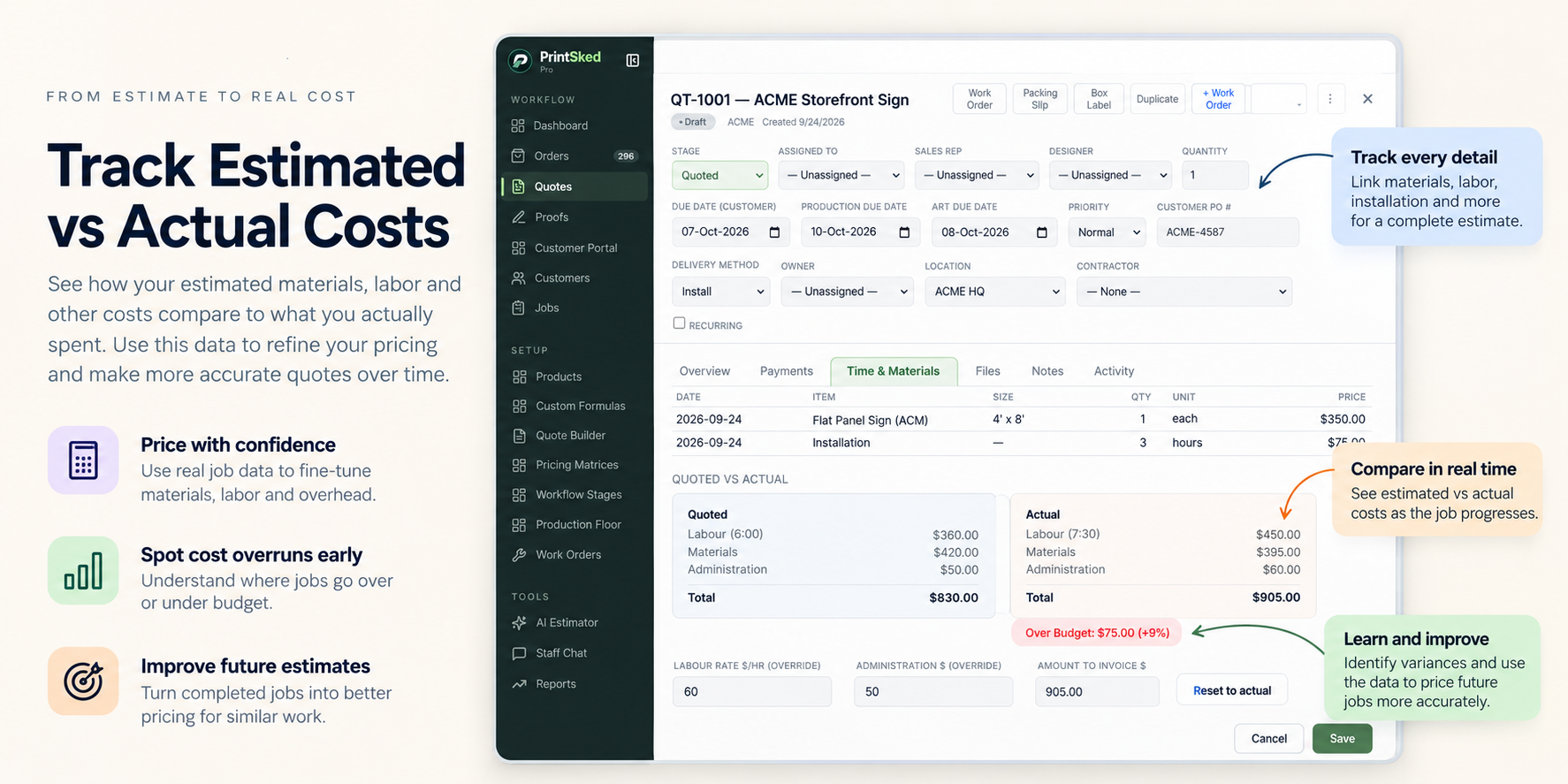
Quoted versus actual cost turns completed jobs into pricing data for the next estimate.
One job going over budget does not automatically mean your pricing formula is wrong. Look for patterns.
If flat-panel installs repeatedly take 25% longer than quoted, adjust the installation assumption. If vehicle preparation is consistently underestimated, update the labor allowance. If small jobs regularly miss margin because of setup time, introduce or raise a minimum charge. If one substrate produces more waste than expected, update the yield assumption.
This feedback loop is how estimating becomes more accurate over time. Your best pricing data is often sitting inside work you have already completed.
Common reasons sign estimates miss the mark
Quoting from memory
Experienced estimators develop strong instincts, but memory is difficult to audit and difficult to teach. Use experience to challenge the estimate, not replace the cost structure.
Copying the last price without checking the last job
A previous quote may have been underpriced, based on older material costs, or produced under different conditions. If you reuse it, check what actually happened on that job.
Pricing finished area instead of material yield
This is especially risky with sheet goods, roll widths, nested parts, and jobs that generate unusable offcuts.
Ignoring non-production time
File preparation, purchasing, proof revisions, project management, packing, loading, and coordination consume capacity even though they do not happen at the printer or router.
Underestimating installation
Travel, access, crew size, equipment, removal, electrical work, permits, and return visits can exceed the cost of producing the sign itself.
Using markup when you think you are setting margin
This produces lower gross margin than intended. Keep the distinction explicit in your pricing system.
Never reviewing completed jobs
If estimated and actual performance are never compared, the same estimating mistake can survive for years.
A practical pre-send checklist for sign estimates
Before sending a significant sign quote, check the estimate one last time:
- Scope: Are size, quantity, construction, finish, and deliverables clear?
- Material: Did you price actual sheets, roll usage, waste, and yield?
- Graphics: Are print, laminate, vinyl, paint, and finishing included?
- Labor: Did you include design/prepress, production, fabrication, finishing, and packing where needed?
- Hardware: Are frames, posts, brackets, fasteners, anchors, LEDs, power supplies, and other components covered?
- Outsourcing: Are vendor costs current, with room for coordination and risk?
- Installation: Are crew hours, travel, equipment, access, removal, and cleanup included?
- Permits and engineering: Are they included, excluded, or listed as allowances?
- Overhead: Does your pricing method recover the cost of operating the shop?
- Margin: Are you calculating the margin you actually intend to earn?
- Terms: Are deposit, payment, timing, assumptions, and exclusions clear?
- Handoff: Will production receive the same scope the customer approved?
Accurate estimating is a system, not a perfect formula
No formula can remove every unknown from custom sign work. The goal is to make the known costs visible, handle uncertainty deliberately, and learn from completed jobs.
Start by defining the scope. Estimate material based on real usage. Separate fabrication, shop labor, and installation. Recover overhead. Set the selling price using the margin you actually want. Then compare the estimate with the completed job and update your assumptions.
When that process becomes repeatable, quoting gets faster without becoming careless. More importantly, you can explain where the price came from and know whether the job is likely to be worth doing.
Build sign quotes from real shop costs.
PrintSked connects products, custom pricing, quotes, jobs, time and materials, and actual job costs so your estimating process can improve with every completed job.
Start free trialBook a demo